
[Original tutorial from Lovely Crafty Home, 11/9/2011] My brown paper floors are by far my most viewed content, at the top of the list for FAQs, and seen more on Pinterest than anything else I’ve done. It was even featured in several magazines, like Natural Home & Garden, and WNC Woman. I think that’s kinda cool for such an easy and cheap floor solution! But I cannot take credit for this method alone, I originally saw this idea in a magazine that featured Jami from An Oregon Cottage. I changed a few things about the process to suit my tastes, but her site is also a great resource.
I wanted to put all the details in one place (instead of scattered over several posts) to make it easier for you to start your project. Keep in mind this is the method I have done in my house over plywood subfloors. There are other methods out there, but I can only tell you what has worked for me. If you have cement/concrete subfloor, or are applying it over an existing floor, these instructions as written may not work.
I also HIGHLY recommend getting a piece of scrap wood and testing the technique with your stain and poly of choice. I get a lot of people asking for help after they’ve done the whole room because the paper isn’t sticking, the stain isn’t even, or the poly is cloudy. At this point, it is very difficult for me to help. The way I developed my method was by getting a piece of plywood and trying it out. Yes it is extra work, but it is worth it to know exactly how the floor will look. I see mostly positive results and comments from people trying this in their home…but there are a few of you who report fails on several different levels. I cannot pinpoint the exact reason why it works for some and not for others, all things being equal. I am sort of gutsy when it comes to making major changes, but I suggest that you really think about this before ripping up whatever flooring you already have. It is a big job, not difficult, just time consuming. If you are not sure you could deal with a few imperfections or worst case, a total fail- you may want to think about it a little longer. I am sharing my own experience here, and I am not a flooring professional.
Before you rip up your flooring, get a piece of scrap plywood (or something similar to your subfloor), and practice the technique from start to finish, including several coats of poly.
But remember you will be working in a larger area than your sample. I do not recommend applying stain by hand in any way unless you can reach wall to wall (a hallway or staircase). It’s next to impossible to maintain a wet edge in larger rooms, and you will likely end up with lines. Once the stain has dried though, you have a few choices when applying poly. Personally I prefer the spongepad mop, but if you are more comfortable applying poly with a brush by hand…that may work best for you. If you have never applied poly before, a brush is the easiest way to control the amount. It is important that the poly be applied not to thin, not too thick. More often I think cloudiness occurs from a too-thick coat, but it can also happen if you apply it too thinly. The only way to find the right amount and application method is to test it in advance. You can also start in a closet, if available.
With that said, if you’re ready to make a change, let’s get started! Want to rid your house of bad carpet/linoleum/vinyl/etc?! Here’s what you’ll need for a large room:
- Brown craft paper on a roll (Home Depot is where I got mine)
- Elmer’s Glue (by the gallon, check A.C. Moore/Michaels/other craft stores)
- Small bucket
- Paint brush
- Roller tray
- Stain (optional, I used Minwax Dark Walnut)
- Floor Grade Polyurethane
- Sponge pad on wood block mop head to apply poly
- Lambskin stain pad refill (if you’re using stain- this fits on the same wood block as above)
- Extension pole (universal screw in connection for the mop blocks or paint rollers)
- 3″ chip brush
- Gloves
The start up materials cost about $150, but will likely last for a few rooms (or into other projects, it’s always handy to have an extension pole).
First things first, prepare your floor. In my case, that involved removing the carpet, pad, and staples. I also sanded down any high spots (our subfloor had areas with plaster/glue or something on them), filled any deep nail holes, hammered in any loose nails, and filled any gaps between boards. Keep in mind when using filler that you usually want to overfill a bit because even though the package says it won’t shrink-it does. When it’s set, sand the filler down flush with the floor.

I’ll be the first to tell you that I absolutely hate prep work-especially sanding. But trust me, don’t skip this. Go ahead and tape off your baseboards if you really don’t want to do any touch up work. Once your floor is filled, sanded, and vacuumed (or swept), you’re ready for the paper.
It is probably faster to tear a bunch of paper, wad it up into garbage bags, then start. But I pretty much tear as I go, somehow seeing the progress helps and also allows me to take a break from sitting on the floor with glue hands. Get out your roll of paper and start tearing-keeping the pieces with straight edges separate from the ones torn from the middle of the roll. I like my pieces to be anywhere from 6″-12″ in diameter, but it really depends on the look you want. The smaller the pieces, the more wrinkly/leathery/vein-y the final result will be. As you tear, crumple the pieces into balls and toss into a bag or pile.
Next, mix up your glue. I don’t like to mix a lot at a time because you may need to stop or take a break, and you won’t want the glue to dry up and go to waste. I typically mix up 2-3 “batches” using a 3:1 ratio of water:glue- so 6-9 cups of water to 2-3 cups of glue at a time. This will fit it a 2 gallon bucket easily. Stir it up with a paint stick or a gloved hand.
Now you’re ready to start! Using a paint brush, brush the area you’re working in with the glue mixture then dunk 5-6 balls of paper in your glue mix. I have found this is the perfect amount of paper and working time for one person. As soon as you dunk the paper, you want to start submerging it and squeezing it out. I pull each ball out and set it on the floor until it’s time to use it. This is important: do NOT leave the paper in the glue too long. You will only have to leave it in too long once to realize how long that is. It will tear and break down and generally be a pain to use. So just dunk, squeeze, and set aside. Repeat if necessary.

The straight edge pieces are perfect for the back of a stair tread and underneath baseboard. I like to overlap the pieces by a few inches, obviously it will help with durability but it also looks more natural in my opinion. Don’t be afraid to brush glue mix on top of the pieces to help them lay flat and remove wrinkles.

You’ll want to paper yourself out of the room, or in the case of the hallway, leave hopping spots to be filled in later. For a staircase, work every other stair. Heat helps the glue dry, so if you feel like getting out a space heater you can (pictured in the bathroom above). I have found that no matter how large the room-with or without heat- it usually takes no longer than 12 hours (or, overnight) to dry. Once the paper dries, inspect it for areas where the paper might have come up around an edge or wrinkled. Glue down/repair these areas as necessary.
Then, it’s time to stain (if you want). I prefer the look of the stain, but if you like the natural color feel free to skip down below to the polyurethane section. My whole upstairs is done with Minwax Dark Walnut. This is an oil based stain, so it will not clean up easily – keep that in mind. I have never used a water based stain, but I have had someone comment that they tried it and didn’t get good results. If you want to use water based stain, test it on some scrap paper first before proceeding.
If you’re doing a room I highly recommend the extension pole/stain pad route. Here’s a neat tip to keep your roller trays in good shape: slide them into a small garbage bag and tape to secure. This is great for any oil based product, but helpful for latex paint too!

Grab your extension pole and attach the lambswool pad to the wood block (if you’ve bought them separately, or bought one that came with the foam pad attached) by removing the wing nuts. The lambswool pad is meant for oil based products, so if you’re using water based stain this will not work (you’ll likely need two of the foam pads). Vacuum the lambswool pad for a minute to remove any loose fur or use a lint brush if your vacuum doesn’t have a hose. I cannot stress the importance of this step enough.
The extension pole screws into a threaded hole on the wood block. It may take a few tries to get it to go, as the block and pad end up being more angled then you might think. It’s not a 90 degree joint, so just look closely at the threads and try to line up the pole. Maybe that’s too much information, but I seriously almost threw the whole thing out the window the first time I tried this. I was convinced that “universal” was false advertising on the pole’s part.
Once you’ve got your stain pad-on-a-stick assembled, set your mop aside. Pour some stain into your roller tray. Using the chip brush, cut in around baseboards and trim. The stain pad makes staining a pretty quick process, so you can really cut in a fairly large area (like a whole wall or closet). When using the brush, dip it in the stain and then dab it in the top of the roller tray to remove excess. You really do not want to apply stain with a heavy hand. It is much better to need to dip your brush more often than to have a puddle of stain you need to disperse. It is for this reason that I absolutely DO NOT suggest the use of a foam brush (the black craft kind). I have tried them and trust me-the chip brush is much easier to control and about the same price. When cutting in, be sure to “pull” the stain out a good bit from the wall, about 6″ or so. This will make it easier to blend the edges with the bulky mop pad without jamming your baseboard or wall.
Make sure you open any windows in the room before you start in with the mop because you won’t be able to access them later. Dip the stain pad-on-a-stick into the stain then blot it on the upper half of the tray by pushing gently downward to remove excess. Using long mop like movements, brush the stain on the floor in large sections. Blend it into the areas where you’ve cut in. I have found that staining the paper is a lot different than staining wood. Once you’ve laid down most of the stain from the pad (a few long straight mop strokes), you’ll have enough stain on the pad left to swirl around the edges and blend. While the stain is wet, you can move it pretty easily. I like to move it around until most of the stain looks like it’s absorbed into the paper and not just sitting on top, feathering out the edges as necessary. Just don’t try to go back over it a few minutes later. Remember to mop yourself out. This is sometimes easier said than done, so just plan carefully.


The Ultimate Brown Paper Flooring Guide
November 9, 2011 560 Comments
Check out my floors in the May/June 2012 issue of Natural Home and Garden!


Also featured in the November 2012 issue of WNC Woman!
My brown paper floors are by far my most viewed content, at the top of the list for FAQs, and seen more on Pinterest than anything else I’ve done. I think that’s kinda cool for such an easy and cheap floor solution! But I cannot take credit for this method alone, I originally saw this idea in a magazine that featured Jami from An Oregon Cottage. I changed a few things about the process to suit my tastes, but her site is also a great resource.
I wanted to put all the details in one place (instead of scattered over several posts) to make it easier for you to start your project. Keep in mind this is the method I have done in my house over plywood subfloors. There are other methods out there, but I can only tell you what has worked for me. If you have cement/concrete subfloor, or are applying it over an existing floor, these instructions as written may not work. Please click here for advice from others.
I also HIGHLY recommend getting a piece of scrap wood and testing the technique with your stain and poly of choice. I get a lot of people asking for help after they’ve done the whole room because the paper isn’t sticking, the stain isn’t even, or the poly is cloudy. At this point, it is very difficult for me to help. The way I developed my method was by getting a piece of plywood and trying it out. Yes it is extra work, but it is worth it to know exactly how the floor will look. Please understand that I get a lot of questions about this technique, and may not be able to get back to everyone in a timely manner, but I do try. A lot of help can be found in the comments section. I see mostly positive results and comments from people trying this in their home…but there are a few of you who report fails on several different levels. I cannot pinpoint the exact reason why it works for some and not for others, all things being equal. I am sort of gutsy when it comes to making major changes, but I suggest that you really think about this before ripping up whatever flooring you already have. It is a big job, not difficult, just time consuming. If you are not sure you could deal with a few imperfections or worst case, a total fail- you may want to think about it a little longer. I am sharing my own experience here, and I am not a flooring professional.
Before you rip up your flooring, get a piece of scrap plywood (or something similar to your subfloor), and practice the technique from start to finish, including several coats of poly.
But remember you will be working in a larger area than your sample. I do not recommend applying stain by hand in any way unless you can reach wall to wall (a hallway or staircase). It’s next to impossible to maintain a wet edge in larger rooms, and you will likely end up with lines. Once the stain has dried though, you have a few choices when applying poly. Personally I prefer the spongepad mop, but if you are more comfortable applying poly with a brush by hand…that may work best for you. If you have never applied poly before, a brush is the easiest way to control the amount. It is important (from what I’m reading from people who have tried it), that the poly be applied not to thin, not too thick. More often I think cloudiness occurs from a too-thick coat, but it can also happen if you apply it too thinly. The only way to find the right amount and application method is to test it in advance. You can also start in a closet, if available.
With that said, if you’re ready to make a change, let’s get started! Want to rid your house of bad carpet/linoleum/vinyl/etc?! Here’s what you’ll need for a large room:
- Brown craft paper on a roll-$11 (Home Depot is where I got mine)
- Elmer’s Glue (by the gallon, check A.C. Moore/Michaels/other craft stores)- use a 40% off coupon, it will run about $12
- Small bucket
- Paint brush
- Roller tray
- Stain (optional, I used Minwax Dark Walnut)- $8
- Floor Grade Polyurethane (I used this in semi-gloss)- $40
- Sponge pad on wood block mop head to apply poly- $5
- Lambskin stain pad refill (if you’re using stain- this fits on the same wood block as above)- $6
- Extension pole (universal screw in connection for the mop blocks or paint rollers)-$9
- 3″ chip brush– $1.50
- Gloves
The start up materials cost about $100, but will likely last for a few rooms (or into other projects, it’s always handy to have an extension pole). I did about 650 sq ft in my home for around $200.
First things first, prepare your floor. In my case, that involved removing the carpet, pad, and staples. I also sanded down any high spots (our subfloor had areas with plaster/glue or something on them), filled any deep nail holes, hammered in any loose nails, and filled any gaps between boards. Keep in mind when using filler that you usually want to overfill a bit because even though the package says it won’t shrink-it does. When it’s set, sand the filler down flush with the floor.

I’ll be the first to tell you that I absolutely hate prep work-especially sanding. But trust me, don’t skip this. Go ahead and tape off your baseboards if you really don’t want to do any touch up work. Once your floor is filled, sanded, and vacuumed (or swept), you’re ready for the paper.
It is probably faster to tear a bunch of paper, wad it up into garbage bags, then start. But I pretty much tear as I go, somehow seeing the progress helps and also allows me to take a break from sitting on the floor with glue hands. Get out your roll of paper and start tearing-keeping the pieces with straight edges separate from the ones torn from the middle of the roll. I like my pieces to be anywhere from 6″-12″ in diameter, but it really depends on the look you want. The smaller the pieces, the more wrinkly/leathery/vein-y the final result will be. As you tear, crumple the pieces into balls and toss into a bag or pile.
Next, mix up your glue. I don’t like to mix a lot at a time because you may need to stop or take a break, and you won’t want the glue to dry up and go to waste. I typically mix up 2-3 “batches” using a 3:1 ratio of water:glue- so 6-9 cups of water to 2-3 cups of glue at a time. This will fit it a 2 gallon bucket easily. Stir it up with a paint stick or a gloved hand.
Now you’re ready to start! Using a paint brush, brush the area you’re working in with the glue mixture then dunk 5-6 balls of paper in your glue mix. I have found this is the perfect amount of paper and working time for one person. As soon as you dunk the paper, you want to start submerging it and squeezing it out. I pull each ball out and set it on the floor until it’s time to use it. This is important: do NOT leave the paper in the glue too long. You will only have to leave it in too long once to realize how long that is. It will tear and break down and generally be a pain to use. So just dunk, squeeze, and set aside. Repeat if necessary.

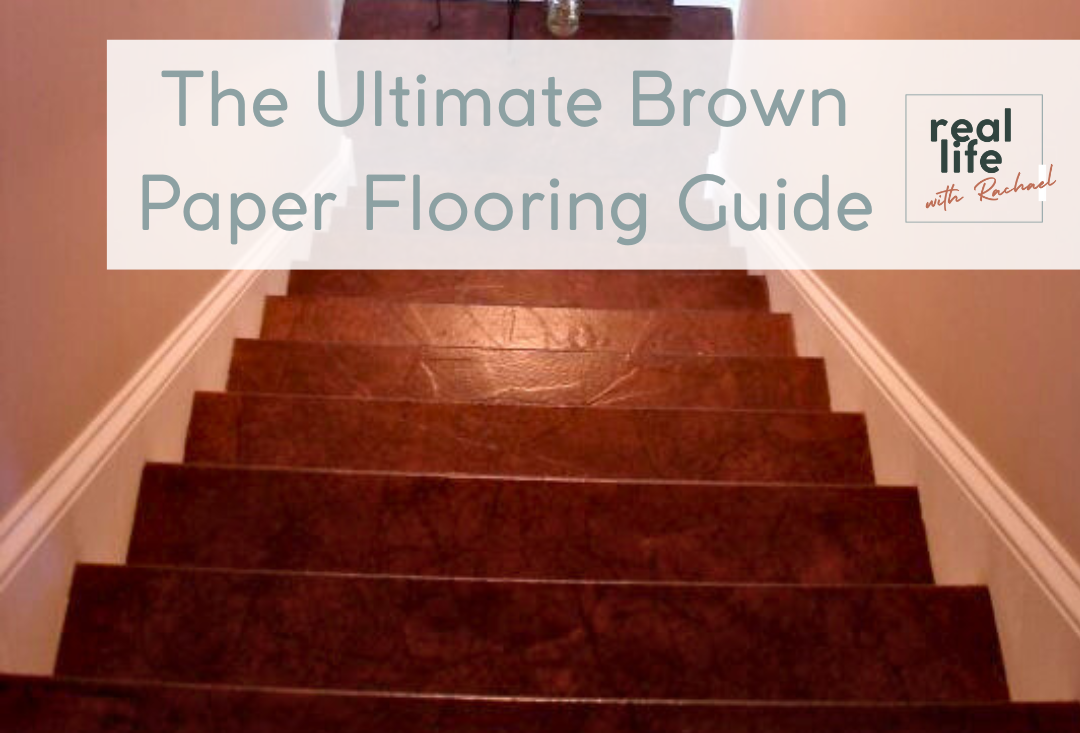
The straight edge pieces are perfect for the back of a stair tread (shown above) and underneath baseboard. I like to overlap the pieces by a few inches, obviously it will help with durability but it also looks more natural in my opinion. Don’t be afraid to brush glue mix on top of the pieces to help them lay flat and remove wrinkles.

You’ll want to paper yourself out of the room, or in the case of the hallway, leave hopping spots to be filled in later. For a staircase, work every other stair. Heat helps the glue dry, so if you feel like getting out a space heater you can (pictured in the bathroom above). I have found that no matter how large the room-with or without heat- it usually takes no longer than 12 hours (or, overnight) to dry. Once the paper dries, inspect it for areas where the paper might have come up around an edge or wrinkled. Glue down/repair these areas as necessary.
Then, it’s time to stain (if you want). I prefer the look of the stain, but if you like the natural color feel free to skip down below to the polyurethane section. My whole upstairs is done with Minwax Dark Walnut. This is an oil based stain, so beware. I have never used a water based stain, but I have had someone comment that they tried it and didn’t get good results. If you want to use water based stain, test it on some scrap paper first before proceeding.
If you’re doing a room I highly recommend the extension pole/stain pad route. Here’s a neat tip to keep your roller trays in good shape: slide them into a small garbage bag and tape to secure. This is great for any oil based product, but helpful for latex paint too!

Depending on how long your stain has been sitting on the shelf, you might want to store it upside down overnight to help get the colorant off the bottom of the can. Then you will need to stir it VERY well.
Grab your extension pole and attach the lambswool pad to the wood block (if you’ve bought them separately, or bought one that came with the foam pad attached) by removing the wing nuts . The lambswool pad is meant for oil based products, so if you’re using water based stain this will not work (you’ll likely need two of the foam pads). Vacuum the lambswool pad for a minute to remove any loose fur or use a lint brush if your vacuum doesn’t have a hose. I cannot stress the importance of this step enough.
The extension pole screws into a threaded hole on the wood block. It may take a few tries to get it to go, as the block and pad end up being more angled then you might think. It’s not a 90 degree joint, so just look closely at the threads and try to line up the pole. Maybe that’s too much information, but I seriously almost threw the whole thing out the window the first time I tried this. I was convinced that “universal” was false advertising on the pole’s part.
Once you’ve got your stain pad-on-a-stick assembled, set your mop aside. Pour some stain into your roller tray. Using the chip brush, cut in around baseboards and trim. The stain pad makes staining a pretty quick process, so you can really cut in a fairly large area (like a whole wall or closet). When using the brush, dip it in the stain and then dab it in the top of the roller tray to remove excess. You really do not want to apply stain with a heavy hand. It is much better to need to dip your brush more often than to have a puddle of stain you need to disperse. It is for this reason that I absolutely DO NOT suggest the use of a foam brush (the black craft kind). I have tried them and trust me-the chip brush is much easier to control and about the same price. When cutting in, be sure to “pull” the stain out a good bit from the wall, about 6″ or so. This will make it easier to blend the edges with the bulky mop pad without jamming your baseboard or wall.
Make sure you open any windows in the room before you start in with the mop because you won’t be able to access them later. Dip the stain pad-on-a-stick into the stain then blot it on the upper half of the tray by pushing gently downward to remove excess. Using long mop like movements, brush the stain on the floor in large sections. Blend it into the areas where you’ve cut in. I have found that staining the paper is a lot different than staining wood. Once you’ve laid down most of the stain from the pad (a few long straight mop strokes), you’ll have enough stain on the pad left to swirl around the edges and blend. While the stain is wet, you can move it pretty easily. I like to move it around until most of the stain looks like it’s absorbed into the paper and not just sitting on top, feathering out the edges as necessary. Just don’t try to go back over it a few minutes later. Remember to mop yourself out. This is sometimes easier said than done, so just plan carefully.


This next part is probably the hardest. After doing several rooms/areas in all weather conditions, I have never found that the stain dries completely….but you really, really need to let it dry as long as possible. I do not suggest doing this in humid weather unless you have at least 2 days to let the stain dry. It may still be a little tacky, even after 24 hours. It took me a few tries to come up with the best method of applying the polyurethane given this annoying situation. You’ll be mopping first, then cutting in.
I used a water based poly because it is a quick dry and less smelly. Considering the amount of time spent applying it, I highly recommend going this route. It is more expensive, but please do not make your decision based on price (this is already such a cheap flooring solution). If you choose oil based poly, test it in an inconspicuous area first! I have had MANY reports of oil based poly leaving splotches…so use at your own risk.
Using the extension pole again, attach the foam mop head to the wood block. Cover your roller tray with a garbage bag and pour in your poly of choice. Dip the mop head in the poly, blot out the excess, then apply it in long strokes on the floor. Stay away from the walls, you can cut this area in with a brush later. Be quick and wear socks. Just get that first coat down with minimal walking. It doesn’t have to be perfect, but it does have to be THIN. People have been reporting cloudy results, and this is generally caused by 1) thick coats applied consecutively and 2) not allowing the coats to dry sufficiently in between. Once the first coat dries, any tackiness from the stain will be gone and you can take your time cutting in around the baseboards and applying subsequent coats. Follow the directions for re-coating that your brand of poly suggests. I recommend no less than 12 coats.
I get asked a lot about sanding in between coats. The truth of the matter is that it does make a difference in how the floor feels under foot. It likely extends the life of the floor as well. However, who wants to sand an entire room? I didn’t. I sanded my stair treads and landing, and these areas are really smooth and lovely. But of course- these areas are also not covered with rugs and furniture. So to me it’s a trade off. If you want perfectly polished looking smooth floors, definitely sand with 220 grit-maybe not between each coat but definitely after the first and before the last.
To really finish the look, install quarter round or shoe molding. I’m in the process of starting this in my master bedroom, and it looks amazing.
FAQs
1. How does the floor wear? Is it durable?
Well, it’s paper. So, considering that…it is remarkably durable. Once the poly is fully cured (sometimes up to a week), I find it is pretty resistant to scratches from normal traffic. I have a large dog and she can scratch the floor if she gets really crazy. It is similar to hardwoods in that way. I can’t guarantee it will last for 10 years, but I have heard that it can. It’s all in the application and general care of the floors. We have area rugs and felt feet on our furniture. I do not have this installed in a bathroom or kitchen. Update: This held up well in our home until we sold it in 2019. Yes, it sold with a PAPER FLOOR.
2. How long does it take?
I would say no matter how small the area, you’ll need at least 3 days without stain and 4 with stain.
3. What if my subfloor is not plywood?
You’ll need to test in a small area first.
4. How do I care for my floor?
I use the hard floor attachment on my vaccuum often, but sweeping will work too. Remember that dirt particles wear away the finish on any hard surface floor. I swiffer style mop (not a wet mop) mine about once a week. Here are some products I’ve found to be safe:
- Mrs. Meyers All Purpose Cleaner (either in the ready to use spray, or buy the concentrate and mix per directions)
- Vinegar/Water mix (a couple tbs to a quart of water)
- Holloway House Quick Shine Floor Finish (a liquid you mop on) <—-this stuff is THE JAM. It makes the floor look like it did day one and hides minor scratches very well
And now here are some final shots from my house to get you motivated! Keep in mind all of these photos were taken on different days in different light, and you can see variation in how the floor photographs. But in person, it is very seamless and uniform. There are obviously a lot of choices when it comes to home flooring, so whether you choose to try the brown paper floor or not, I hope this tutorial was helpful in deciding!


